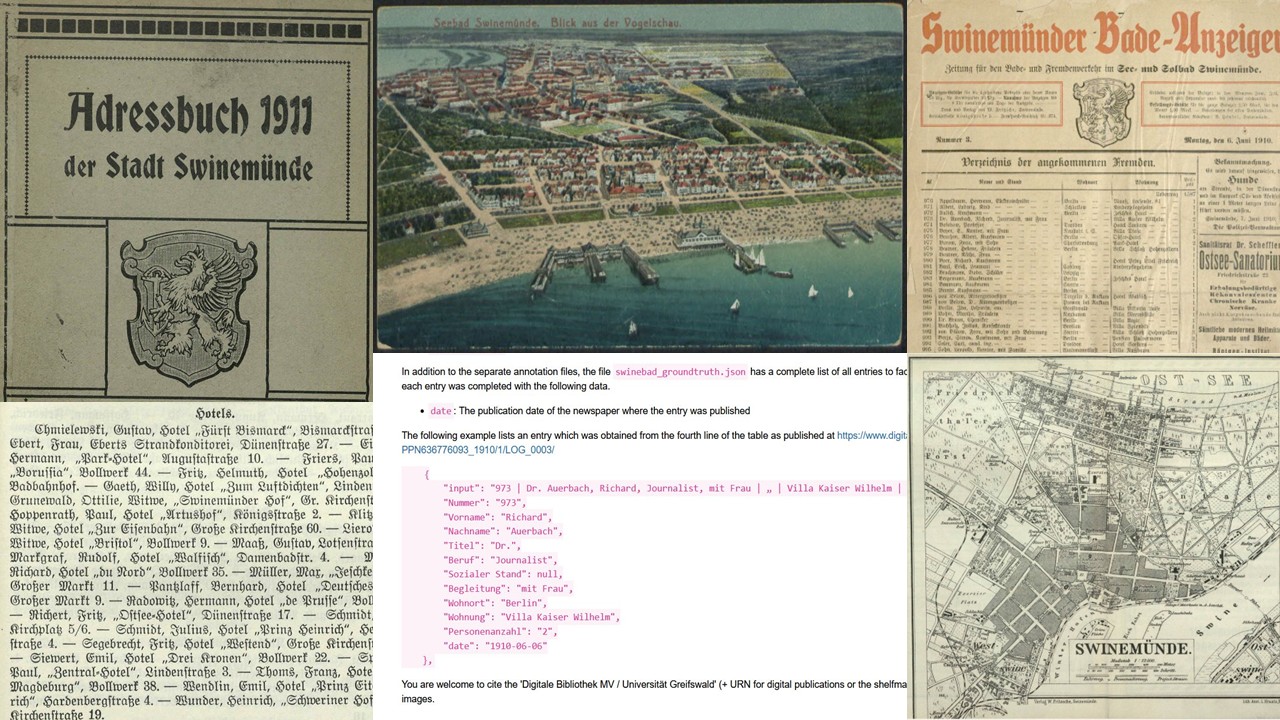
Greifswald – What actually happens to our digitised cultural treasures once we’ve uploaded them to the Digital Library of Mecklenburg-Western Pomerania? In other words: how are they used, and by whom? The statistics tell us how often they’ve been looked at, but are they also being put to further use?
In fact, they’re leading to some fantastic follow-up projects!
In collaboration with Dr Fabian Schmitt, the Digital Humanities Specialist at Greifswald University Library, we welcomed Prof. Frank Krüger from Wismar University of Applied Sciences on 9 June, who presented the (now completed) ‘SwineBad’ project to us. His project team extracted the guest lists from the Swinemünder Badeanzeiger (1910–1930) and made them available as JSON data. This is what it looks like:
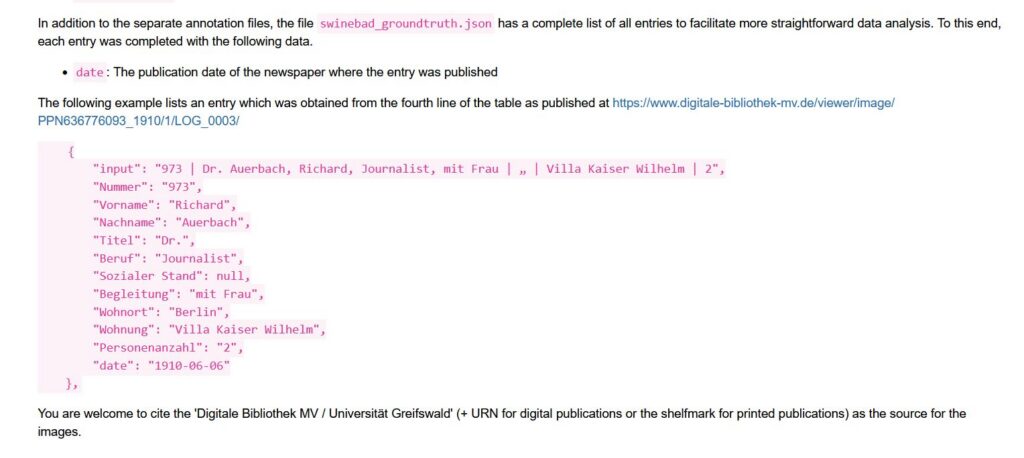
Using this data, it is possible to determine where most of the guests came from (Berlin) or what their professions were (merchants are quite common…). Of course, depending on the seaside resort, famous personalities can also be found. In Swinemünde, the artist Lyonel Feiniger, who enjoyed spending his summers on Ruegen and Usedom, was a guest at least twice.
But where exactly were the hotels and vacation rentals mentioned in this data? You can figure that out by cross-referencing this data with information from address books or newspapers. That’s where we come in again: for this, you’ll need at least the scans, and ideally the (more or less) automatically transcribed text (OCR) as well. The address books of Świnoujście are now high on our to-do list so that we can add this data as well…
(Greifswald University Library)
Note: The SwineBad data can be downloaded from https://github.com/ORDS-MV/SwineBad.