

WITCH TOUR
through Western and Northern Pomerania
Anyone wishing to follow in the footsteps of the witches in Pomerania will find what they’re looking for in various places. On the one hand, there are still traces of the cruel witch hunts: prison cells and gallows hills, on which – usually just outside the town – alleged witches were hanged or even burnt. On the other hand, you can, of course, also set out in search of the healing powers of certain herbs: who can recognise the witch’s herb (Circaea)? So, anyone more interested in the natural powers of the ‘witches’ – powers that were, at the very least, utilised by the medically knowledgeable men and women of the time – can explore the region’s numerous botanical gardens. Those who prefer a more fairy-tale atmosphere will also find enchanted forests where many a tree resembles a mythical creature...
Barth
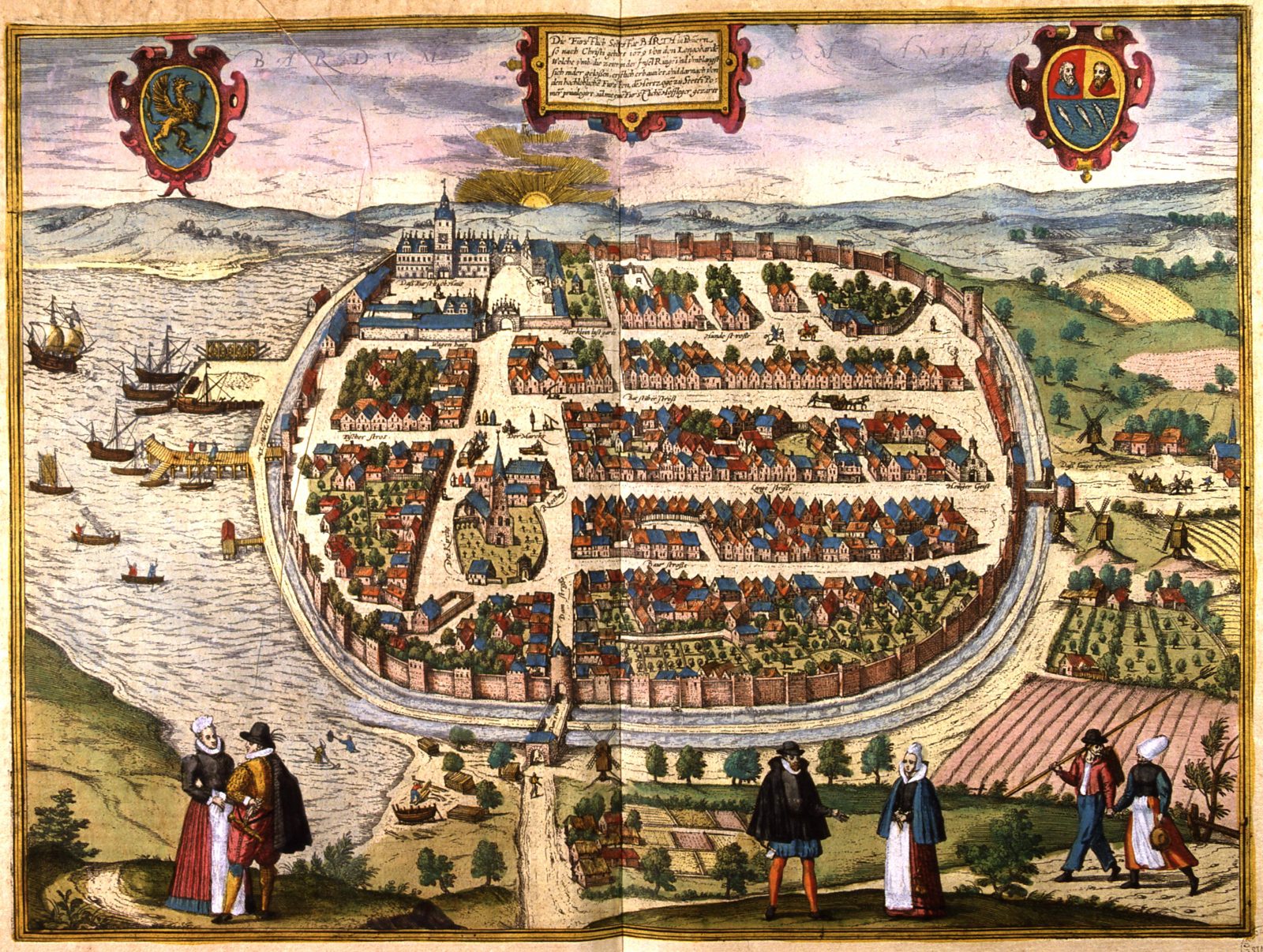
Over 40 witch trials were held in Barth between 1578 and 1653. Presumably, those accused of witchcraft were also thrown into the dungeon of the Fangelturm before quite a few of them met their end at the stake. The deeply sunken dungeon was sealed off in the 18th century, but has since been uncovered and can now be visited.
The chronicle of the town of Barth sheds light on the witch trials from the perspective of the early 20th century. More information on the subject of witches in Barth can also be found here: link
Stralsund
From Barth, the journey continues to Stralsund – where, in 1558, what are believed to be the first Pomeranian ‘witches’ were burned. Nikolaus Gentzkow’s diary (link) mentions that on 23 March 1558, three women and one man were burned at the stake in Stralsund. One of the women, Woltbrecht Vosses, had lived in a flat he rented, directly behind St Mary’s Church. During a ‘gruelling interrogation’ (i.e. under torture), she is said to have admitted to having conjured up two devils, on whose advice she administered medicines. Buildings dating from the Middle Ages still stand behind St Mary’s Church today (e.g. Marienstraße 19), and Stralsund’s old town is a UNESCO World Heritage Site.
From here, you can travel on to Rügen and discover enchanting trees in the Märchenwald (Fairytale Forest) or set off in search of medicinal herbs, for example at the Kräuterhof Rügen. There are numerous legends set on the island of Rügen, including stories of witches and wizards (link). Many of these have been passed down orally from Trent.
Grimmen
‘There used to be many witches in the town of Grimmen,’ according to the legends of the Grimmen district. (link
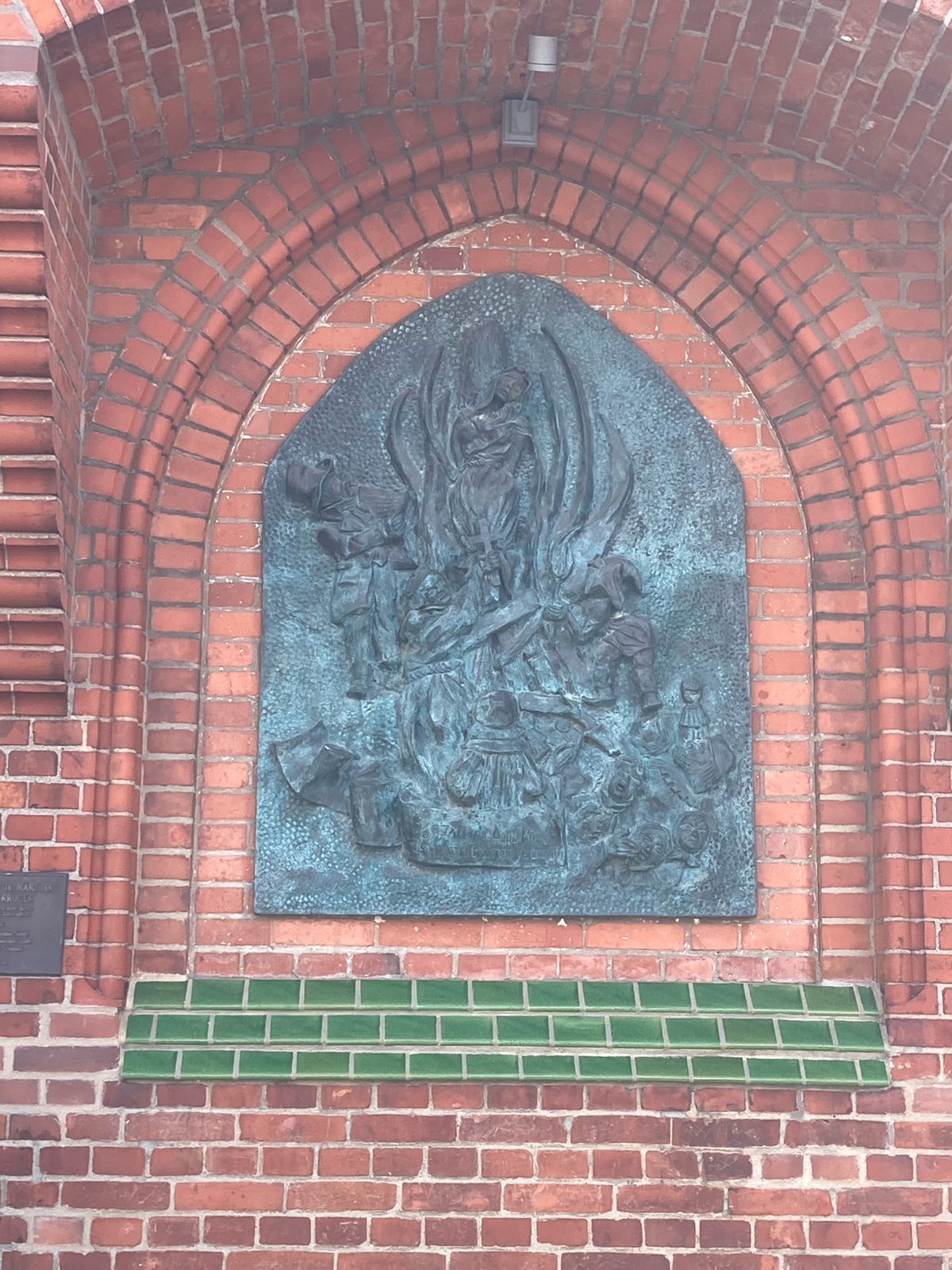
Some of those persecuted as witches here are known by name. In 2006, the town dedicated a relief to the last known ‘witch’, Anna Kröger, who was burnt at the stake in 1697; this can be seen on the town hall building on Lange Straße. An overview of beliefs about witches in Grimmen can be found in the essay ‘Witches and Witchcraft in Old Grimmen’ (1931) here (link)
Greifswald
When the Great Bell of St Mary’s Church in Greifswald was due to be recast in 1621, both the first and, shortly afterwards, the second attempt failed. A witch must surely be to blame! A woman known as ‘Die Glantzesche’ was accused of having ruined the bell. Under torture, the poor woman ‘confessed’ and was burnt at the stake in 1622. (link). Her case was also dealt with in the judicial records of the Greifswald Faculty (which considered her guilt to have been proven). Link
There is also a prison tower in Greifswald, built in the Middle Ages and used in part as a dungeon: the Fangenturm. It is not known whether those suspected of witchcraft were held captive there. In any case, you can learn about medicinal herbs in the botanical garden, where you’ll find great witch’s herb. The historic greenhouses, which are well worth seeing, date from the 19th century, however. There are also several legends about witches in and around Greifswald (link).
Usedom
On Usedom, there are still numerous other traces of the persecuted witches, as well as many legends surrounding witches (link).
Zempin (Hexenheide)
In some places, the superstitious names from the early modern period have survived. Near Zempin, for example, you can enjoy a wonderful walk across the ‘Hexenheide’ (Witches’ Heath). The area is certainly enchanting. To ensure that the cruel punishment to which the alleged ‘witches’ were subjected is not forgotten, a memorial stone here commemorates the witch hunts on Usedom. But there’s also a wishing tree there: who knows, perhaps it really does work? Love locks are effective too, as many bridges and footbridges on Usedom prove.
Koserow (The Amber Witch)
In Koserow, there is now a plaque commemorating the witch hunts that actually took place on Usedom, even though Maria Schweidler from Wilhelm Meinold’s famous novel *The Amber Witch* is a fictional character. If you need a little break from the horrors, you’ll also find the ‘Bernsteinhexe’ restaurant here.
Loddin (Galgenberg)
As the name suggests, ‘Galgenberge’ (gallows hills) were the places where criminals, ‘witches’ and certainly many people who, from today’s perspective, were innocent were executed. Hills were chosen because they were usually situated just outside the village and the executions could be seen from afar. The aim was to create a deterrent effect. In Loddin and also in Barth there is still a ‘Galgenberg’, and in Laage near Rostock there is even the ‘Schmooksberg’, so called because ‘witches’ were burnt (‘geschmökt’) on it.
Penzlin Castle (Museum)
On a tour of Pomerania’s enchanting towns, a short detour to Mecklenburg is highly recommended, as this is where the Museum of Everyday Magic and Witch-Hunts (link) is located. The eerie ‘witches’ cellar’ there has become immortalised in Mecklenburg’s folklore. Even today, you can visit this eerie dungeon and learn about the history of the witch hunts at the museum.
Stargard Castle
The nearby Stargard Castle is also well worth a visit, as it was here that what is thought to be the last witch trial in the Duchy of Mecklenburg-Strelitz took place. Unfortunately, the original sources have since (also) been lost in a fire, but according to this quote from 1936, a 17-year-old girl managed to defend herself just in time... (link)
Stettin/Szczecin
On the Polish side of Pomerania today, witches were also frequently condemned and executed; there, too, efforts are being made to keep the memory of those persecuted alive. In Szczecin, it is said that a witch’s cell can still be visited (link).
Probably the best-known of those persecuted in Szczecin was Sidonia von Borcke (also: von Bork). She was held captive in Oderburg Castle and was eventually beheaded in Szczecin in 1620, after which her body was burned. After her death, she is said to have even haunted Szczecin Castle as a ‘white lady’. Today, there is a dedicated guided tour in Szczecin focusing on Sidonia von Borcke, available in Polish and German.
Open link
Elisabeth von Doberschütz, who came from Neustettin (Szczecinek), was also beheaded in 1590 on what was then the Heumarkt.
Gollenberg (Góra Chełmska)
The Gollenberg is not far from Szczecin: a place of pilgrimage until the Reformation, the Gollenberg was also suspected of being a ‘Blocksberg’, where witches would gather to dance on Walpurgis Night. Even if you no longer come across witches riding broomsticks, it is still a lovely place for a walk; on the summit stands a viewing tower built in 1888. There is also a beautiful view from the Bocksberg in Fiddichow (Widuchowa), which is doubly interesting due to the remains of an ancient castle rampart. Today, there is a viewing platform there too. Further ‘Blocksberge’ are said to be found mainly in Hinterpommern; Alfred Haas mentions several, including one near Groß Reetz (Rzeczyca Wielka). There are also Blocksberge in the area around Cammin, and there is even a legend associated with them.
Witches in Legends and Fairy Tales
There are numerous legends and fairy tales from Pomerania in which magical powers, witches and sorcerers play a significant role. In these too, witches often meet a gruesome end, but for the most part the brutal violence is simply part of the fairy-tale world and is regarded as just as natural as talking animals or glass mountains. In the fairy tale of the ‘beautiful princess’, the old witch has to die no fewer than nine times before she is allowed to ‘enjoy her eternal rest’. Unlike in the fairy tales where all witches – and even the few sorcerers (as in the ‘Fairy Tale of Himphamp’) – are evil, the local legends also feature innocent suspects:
The legend of the innocent sorcerer.
In the village of Boltenhagen in the district of Greifswald there once lived a pious, wise man who was taken for a sorcerer. He was therefore tied to a stake to be burnt alive. But suddenly three fresh green twigs sprouted from the stake, and then everyone realised that he was innocent, whereupon they spared his life. Oral tradition.
As reassuring as it may seem at first glance that an innocent person is saved in the legend, the bar for proving innocence still appears to be quite high.
As the eerie title already suggests, in the legend ‘The Burned Witch of Hohendorf’ a guilty witch is punished – but the fact that a talking raven must first appear to confirm her guilt suggests that some people still harboured doubts as to whether the ‘witch’ might, after all, have been innocent. The learned vicar, who refused to believe in her magical powers, may well have been one of the first to challenge superstition. The moral of the story – “that going to church and reading the Bible alone are not enough” – seems reasonable, but leaves the question open: what is enough, then?
In contrast, the legend of the witch’s broom highlights the alluring side of magic: the hope of wealth and power. In this case, the punishment for it is not even particularly severe.
Witches and hares were closely linked in folklore: witches could transform themselves into hares to get from one place to another quickly and unnoticed – presumably a hare was less conspicuous than a broomstick. On the other hand, three-legged hares were particularly suspicious...
A particularly large number of the legends in Jodocus Temme’s collection of fairy tales from Pomerania originate from Trent on Rügen. Witches and sorcerers, however, also play a significant role in the folklore of Usedom and Wollin. The origins of many of these legends in the real-life witch hunts are unmistakable, at least in the case of some of them.
Superstition is probably widespread everywhere. From Fernowsfelde (now Rabiąż) on Wollin comes this sound advice: “Cow flowers (Calta palustris), scattered in front of the doors of the cattle sheds on St Volbrecht’s Eve, keep the witches away” (Ulrich Jahn, link). Walpurgis Night, the night before 1 May, was known in Pomerania as ‘Volbrechtsabend’ or ‘Wolpersabend’.
Historical background: Witch hunts in Pomerania
Magic fascinates us, with or without a wand – who wouldn’t want magical powers? Today, we know witches from films and literature as clever women with a great deal of self-confidence, whose power is constantly growing. For many centuries, however, belief in ‘witchcraft’ in Europe was largely associated with fear: the Devil was inevitably behind it.
In the early modern period, witches in Europe – unlike in Asian countries – were not admired for their powers or healing arts, but were persecuted, condemned, tortured, hanged or burnt at the stake, even in the predominantly Protestant north-east. The instruments of torture and the ‘witches’ cellar’ at Penzlin Castle (Mecklenburg Lake District, (link) still vividly illustrate today just how cruel the methods were used to ‘convict’ women and men of witchcraft. Around a fifth of the victims were male. Most ‘witches’ were victims of slander, envy or power struggles. Only the very poorest and the outcasts had so little to lose that they no longer even feared the Devil: for some of them, witchcraft seemed the last resort to escape poverty or the only protection against a hostile neighbourhood. Occasionally, there was probably also the intoxicating conviction that they were protected by higher powers, even if these were the Devil’s. The witch hunts, which were based on fear of the power of witches – or, in fact, that of the Devil – in turn tell us a great deal about people’s lives in the early modern period: about their way of understanding the world and about their faith, which was by no means as unshakeable as it sometimes appears. In a pre-scientific world, there were scarcely any explanations for cruel wars, sudden natural disasters, deadly diseases affecting both humans and livestock, or the dreaded town fires that could spread with terrifying speed. All evil was attributed to the Devil, who was always on the hunt for lost souls. Cursing women – such as the ‘Cursing Woman of Demmin’ in the Pomeranian legend – were regarded as a danger to society as a whole, for they brought misfortune upon everyone: their curses lured the Devil, who could then engulf the entire town in an earthly inferno.
However, accusations and charges of witchcraft also reveal a great deal about how conflicts were played out and resolved in earlier times. Often, a witch-hunt was rooted in a dispute: neighbourhood quarrels and family disputes, religious disputes, and conflicts between independence and subordination (particularly among women) did not in themselves trigger a witch-hunt. However, if an inexplicable serious illness or an unexpected death occurred, the conflict escalated into a witch-hunt: the opposing party had taken their revenge. People defended themselves by bringing charges. Socially unacceptable behaviour could also trigger an accusation, and one accusation could mark the start of a wave of persecution that spread as rapidly as a town fire. Under torture, accused witches in turn accused others of ‘witchcraft’, and, at least temporarily, these coerced ‘confessions’ were also regarded as evidence for a further trial, which affected the next victims.
However, according to recent research, witch trials must also be viewed in the context of the history of crime: a comparison with the prosecution of other crimes reveals, for example, what was deemed acceptable and what was not in terms of torture and punishment. A highly interesting case is that of Isabella Schlichtekrull (link:
An unusual case from Anklam, in which the victim sought compensation for the torture she had suffered, is that of Isabella Schlichtekrull (married name Lüdtke/Radtke) from the year 1589 (link). The case illustrates that not everything was permitted, and that a knowledgeable woman such as Isabella Schlichtekrull (or, as she herself wrote her name, ‘Schlichtekrölsin’) was able to invoke Emperor Charles V’s ‘Peinliche Hals- und Gerichtsordnung’ (Code of Criminal Procedure) of 1536 before the Imperial Court Chamber in Speyer to claim compensation for the injustice done to her. She probably never received the money, but the court at least recognised her claim as justified.
The correct conduct of a witch trial was a subject of general debate amongst the legal scholars of the time. The records from the witch trials, as well as the numerous writings published on the subject, reveal that not every alleged witch was in the Devil’s service, not every form of torture was permitted, and not every statement was credible. Not every ‘witch’ was found guilty. Did witches exist, or did they perhaps not exist at all? This debate, too, was hotly contested.
The legends and fairy tales of the time clearly side with witchcraft: of course there are witches! Yet even in the legends, attempts are repeatedly made to find evidence of the witch’s guilt or innocence. Take, for example, the legend of the sorcerer who is tied to a stake because he is to be burnt: suddenly, green twigs sprout from the dead stake, proving his innocence. (It should be noted that this was a form of proof of innocence that was difficult to provide.) A black raven, on the other hand, which appears after a witch has been burnt, reassures those who might still harbour doubts that the witch must indeed have been guilty.
The MV Digital Library provides access not only to the legends but also to historical introductions on the subject and, above all, to original sources: files on witch trials and so-called ‘Spruchakten’ (enquiries to law faculties regarding procedural rules), documents and even leaflets: this helps to paint a more comprehensive picture of the witch hunts.
History of Witches in Pomerania (in the MV Digital Library)
Introductions to the topic of ‘Witchcraft and Sorcery in Pomerania’ can be found, amongst other places, here: (Alfred Haas) link and here (Ulrich Jahn) Open link
The Digital Library also contains numerous original sources from the early modern period. Court cases from that era reveal a great deal about the intellectual world of the people of the time, but they are by no means an easy read. By way of example, we list a few in which all manner of evil forces can be discerned, even if, from today’s perspective, no proof of ‘witchcraft’ is provided.
In the so-called ‘judgement files’, cases were discussed between the local courts and the faculty in Greifswald, including the use of torture as the method of choice to extract a confession, as well as the ‘appropriate’ punishment. One such case described there is that of Anna Maria Kröger (Hermann) from Grimmen. The digital library of the Szczecin Pomeranian Library (Ksianica Pomorska) contains files relating to an early example of witch-hunting in Demmin.
Regarding Sidonia von Borcke, the Mecklenburg-Vorpommern Digital Library contains the criminal trial records from the Greifswald State Archives, as well as the compilation *Sidonia Borcke: Miscellaneous Documents: A Collection of Historical Sources*, including portraits and extracts from the trial records relating to the case of Sidonia von Borcke, compiled by Georg Sello (1901). Other historical sources include leaflets, such as this one with the striking title ‘True and Terrifying Recent Events and Stories: How, both outside and within
the town of Stralsund in this present year 1597, and how on various occasions and in various places it rained blood and brimstone, and fire fell from the heavens upon St Mary’s Church there. Furthermore: of a marvellous vision encountered by a citizen there’ or also
Nikolaus Gentzkow’s diary, which mentions what may have been the first witch burning in Stralsund on 23 March 1558: three women and one man were burned. He reports that the women had conjured up familiars (demonic spirits, often in animal form), with whose help they caused harm to others, and that they had, to some extent, demonstrated their powers.
The witch hunts did not go unnoticed by the authorities, whose duty it was to maintain law and order. It is therefore not surprising that edicts were issued, such as the ‘Polizey Ordnung’ (Police Regulations) from 1672/81:
“Should there also be found in these lands certain individuals who practise divination by the devil’s art, or who converse with the devil through crystals or by other means, practise sorcery, and have entered into certain pacts with the evil enemy, proceedings shall be brought against them in accordance with common and customary law, and every authority is hereby admonished to duly prosecute such abominable vice, and to subject those found guilty to the punishment they deserve by means of a summary yet lawful trial [...] The Police Regulations of the Duchy of Vorpommern. Dated 18 December 1672. As revised and amended in the year 1681.
A hundred years earlier (from 1562), the Mecklenburg police regulations still stipulated that witches and sorcerers were to be punished by burning. (link). This drastic punishment for witches – burning at the stake – was often justified by reference to the fires of hell that awaited them anyway.
On the other hand, works such as Jakob Brunnemann’s *Discurs von betrüglichen Kennzeichen der Zauberey* (1708), published under the pseudonym Aloysius Charitinus, which shows how little credibility the signs of witchcraft – hitherto held to be true – had even at the beginning of the 18th century – that is, at the dawn of the Enlightenment – and demands that witch trials seriously examine the credibility of the signs and witnesses. Brunnemann was a lawyer from Kolberg who initially taught in Halle and later became director of the lay judges’ court in Stargard, Pomerania.
Full-text search functionality makes even handwritten or Fraktur-typeface printed texts searchable; however, with automatic text recognition, it should be noted that names in particular are occasionally transcribed incorrectly.
Witches in literature
The fate of women who were burnt as witches has also been a subject of literary interest since the 19th century. Historical cases are brought to life through the equally magical powers of fiction.
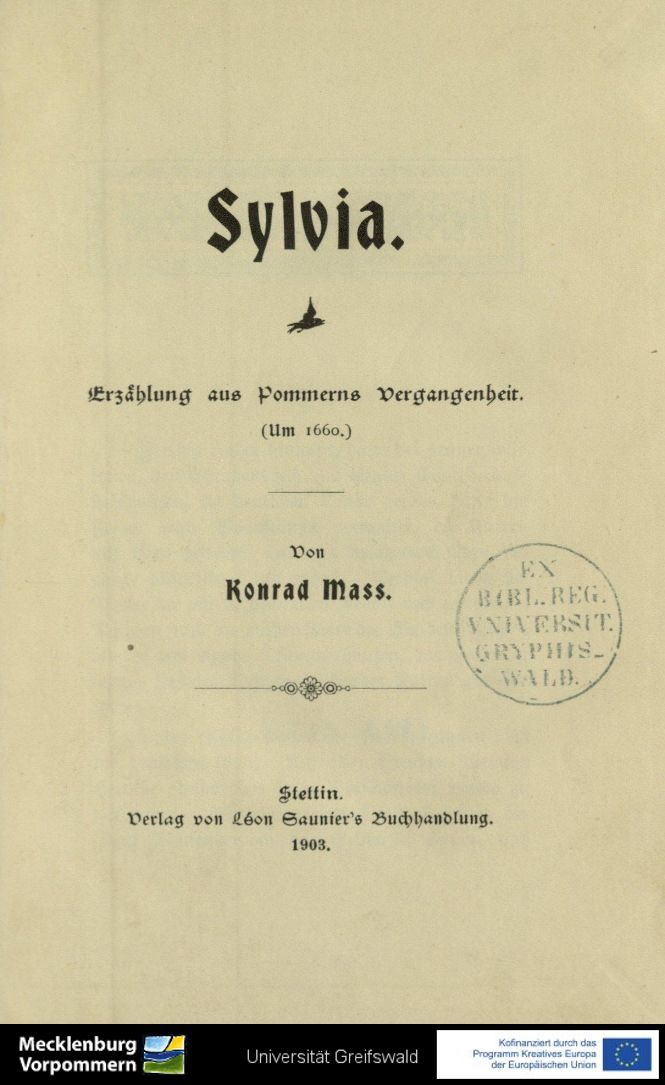
The Digital Library contains a selection of Pomeranian stories on this theme. Konrad Mass, born in Anklam, was an author who explored the history of Pomerania in his stories. ‘Sylvia’ is a relatively little-known work in which the eponymous character, with her black hair and love of nature, seems completely out of place in the period following the Thirty Years’ War. Even though her father is the vicar, it is ‘not long before: so the old women would say as they sat at their spinning wheels, and the men would repeat it to them: the vicar’s daughter was in coworking with a witch, if she wasn’t a witch herself.”
Wilhelm Meinhold’s famous novel *Die Bernsteinhexe* (The Amber Witch) from 1843 is a fictional tale set during the era of the witch hunts, which initially – as was not uncommon at the time – claimed to be based on a true story. Maria Schweidler, the novel’s protagonist, collects and sells amber to buy alms – yet her apparent wealth is viewed with suspicion by the local people. As befits a heroine of a novel, she is young and beautiful – but will she be burnt as a witch...? Wilhelm Meinhold (1797–1851), who hailed from Netzelkow on Usedom, wrote yet another novel about witches, *Sidonia von Bork* (1847), which was also translated into English and even inspired artists and authors in Britain.
Ludwig Hamann’s *Die Klosterhexe von Marienfließ und der Untergang des Pommerschen Herzogs-Geschlechts* is also a novel about Sidonia von Borcke, published in 1910. Her life has been the subject of stories on several occasions. Sidonia’s cruel persecution was recorded early on in legends and short stories; the English translations inspired the Pre-Raphaelite Edward Burne-Jones to create a watercolour. Even Theodor Fontane began to write her story, though this has survived only as a fragment. We have compiled a digital collection of some historical works and legends here. A new release, currently available only in Polish, is Leszek Herman’s 2015 novel *Sedinum. Wiadomość z podziemi* (*Sedinum: A Message from the Afterlife*), which also deals with Sidonia’s life.
Hans Hoffmann (1848–1909) hailed from Stettin and, in his works, brings Pomerania to life both as it was in his own time and throughout history; his focus is on realistic characters experiencing psychological conflicts: in *The Witch Preacher*, it is a preacher from Stettin who goes astray. In his humorous short story *Die Teufelsmauer* (*The Devil’s Wall*), however, the Devil himself makes an appearance, as an undaunted woman is searching for the right husband – even if it were the Devil himself.
Pomerania’s most famous ‘witches’
Elisabeth von Doberschütz from Neustettin was convicted of witchcraft several years before Sidonia von Borcke (1590/91) and beheaded on the Heumarkt in Stettin. She, too, was accused of being responsible for the downfall of the Pomeranian ducal house; in particular, she was said to have given Duchess Erdmuthe of Pomerania a ‘witch’s potion’ that rendered her barren. The historian Max von Stojentin, one of the first to bring her case back to public attention, suspected a political intrigue that was actually directed against her husband. However, the slanderer, Jakob von Kleist, was also responsible for a number of other brutal witch hunts in Neustettin and ultimately even lost the favour of the Duke of Pomerania as a result.
Sidonia von Borcke (1548–1629) is arguably the best-known Pomeranian victim of the witch-hunts. She rebelled against the law of succession, which favoured her brother, and after entering the Marienfließ convent, she fell out with the prioress. Such an independent and combative woman did not conform to the ideals of the time, and her fellow nuns accused her of witchcraft. Under torture, she confessed to having caused the death of Duke Philip II of Pomerania through witchcraft – an obviously coerced confession which she later recanted, but the superstition of the time eagerly seized upon this rumour. Her contemporaries were searching for an explanation for the already looming extinction of the Pomeranian dukes, and diabolical witchcraft offered a comprehensive and therefore plausible ‘explanation’ for the actually very diverse causes that led to the line’s demise (including childlessness, the Thirty Years’ War and early deaths). Von Borcke was beheaded with a sword and subsequently burned (it is possible that, due to her high social standing, she was killed with a sword, but this is unclear). Perhaps another ‘witch’ would simply have been targeted had Sidonia von Borcke not come to public attention as a rebellious woman at precisely that time; or perhaps it was simply believed that only a noblewoman was capable of directing her magical powers even against the princes.
Anna Maria (Kröger) Hermanns
The Grimmer Sagen (link) specifically mention an Anna Maria Hermanns who is said to have been executed in May 1697. In the Greifswald court records of 1697 (2 March), however, there is a reference to an ‘Anna Maria Kröger, wife of Hans Herman’, who was to be executed. The only point of contention in the case was that she might have taught her son witchcraft. In the legend, she has various devils and even a dragon at her disposal. Presumably, the real Anna Maria Kröger Hermann (early records often mention her maiden name as well) would have wished she had a dragon that could have protected her son from the impending persecution. Nothing is known of his fate.
Isabella Schlichtekrull
Another strong-willed woman from Pomerania, whose self-assured way of life seems to have been the real problem: Isabella Schilchtekrull from Anklam was married three times; rumour had it that she had called upon the devil for help whilst in childbirth. It is likely, however, that she was dragged into this ordeal as a result of another witch trial, following a statement extracted under torture from an acquaintance. She was arrested and interrogated in 1589, and tortured on several occasions, yet she refused to confess her guilt – a remarkable feat given the brutal torture methods of the time. She was released from custody but, following a ruling by the Faculty of Law in Greifswald, was forced to leave the province of Pomerania (unfortunately, the court records do not appear to have survived). It was highly unusual for the time that she lodged an appeal with the Imperial Chamber Court and sued the Dukes of Pomerania for damages. She apparently wrote her own letters; these, along with numerous other documents relating to the protracted legal proceedings, have survived and can be found amongst the court records from Speyer and Prague. A summary of the case has been compiled by the renowned folklorist Alfred Haas.